- Apr 2
How to Write a Creative Brief (That Actually Increases Conversions!)
- Sherice Jacob
- Copywriting Tips
I'm going to say the quiet part out loud.
Most clients are the reason their copy doesn't convert.
But, clients, hear me out: it's not your fault.
You've just never learned how to write a creative brief.
So what happens? You hand over something that includes:
A general idea of who the audience is
A surface-level problem
And a product you're way too close to
And the copywriter is left to "figure it out."
What we have here is the perfect recipe for safe, sterile, middle-of-the-road messaging that almost works, but falls short of actually converting.
What a Creative Brief Actually Needs to Do
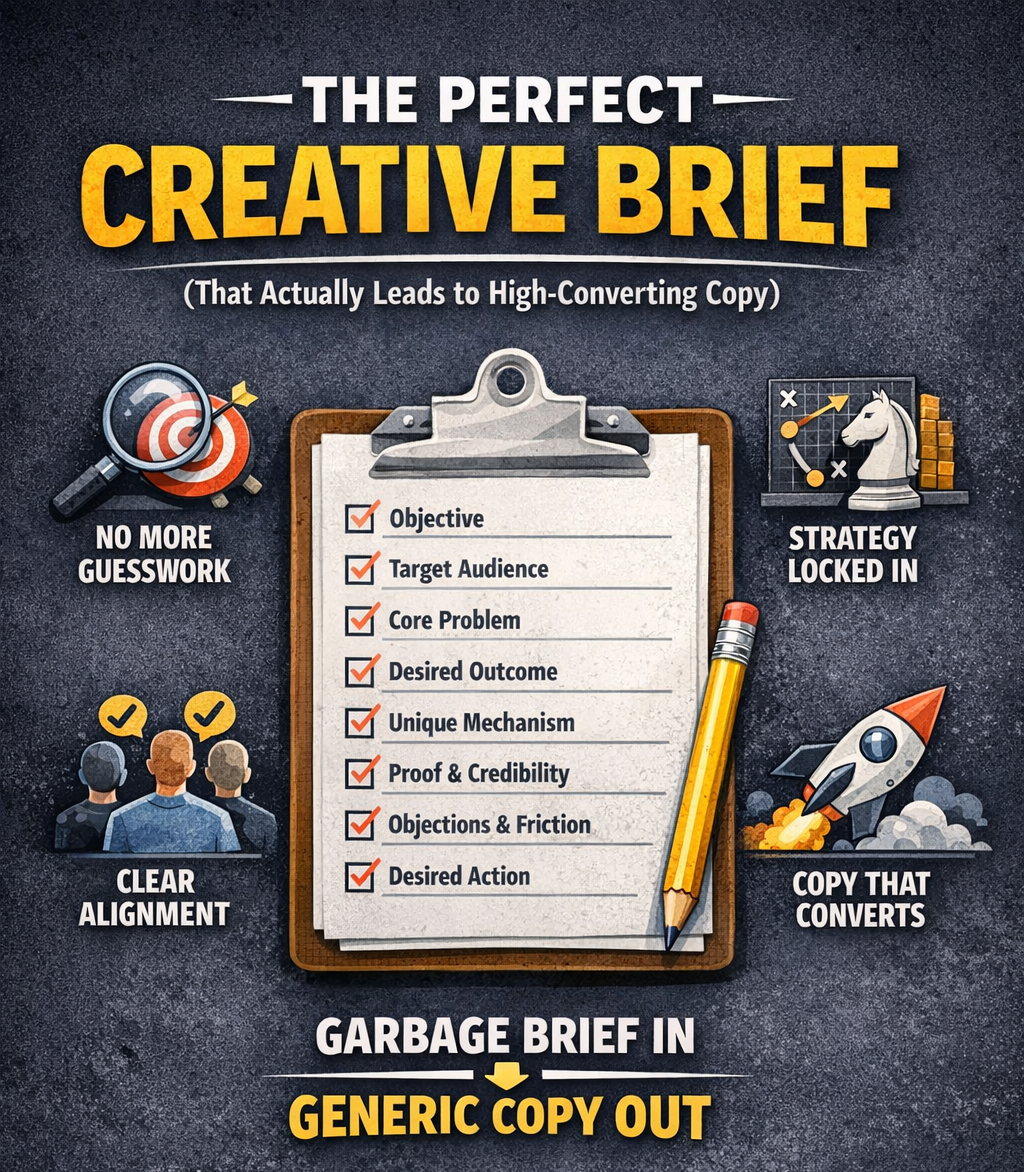
Not what it is -- what it does. A bad creative brief has stuff in it like "Write a homepage" or "We need follow-up emails." A good creative brief has objectives like "Convert cold traffic into trial signups", or "Re-engage users who have been inactive for 7 days."
That sets the "conversion lens" for everything to come.
Your Real Target Audience (Not Just Demographics)
"Small business owners" isn't an audience -- it's a category. We need to go deeper. For your copywriter to craft their absolute best, high-performing copy, they need to go beyond just knowing "their pain points" and include:
The prospect's current situation
What they've already tried
What they're skeptical about
What they secretly want, but might not actually say out loud
That makes your real target audience someone like "Burned-out agency owners stuck doing fulfillment work themselves. They've tried hiring but they got burned. They want to delegate but they're hesitant, even though they know they can't scale without it."
Now you're writing to a real person, and not a vague segment.
What's the Core Problem (From the User's Perspective)?
This is not the same as the problem your product solves. This is the user's problem, and not the first one that comes to mind, either. For example:
Bad: "They need better time tracking."
Better: "They don't know where their team's time is going and it's killing their productivity."
Best: "They feel like they're paying for work that isn't happening, but they struggle to prove it and it's making them question their team."
That's it -- that's the emotional layer where high-converting copy lives.
What Does Success Look Like in Their World?
More control? Less stress? More money? More freedom? Write down what success looks like, such as:
"They want to feel confident their team is productive without having to micromanage. They want to finally see where time is going so they can scale confidently without bottlenecks or growing pains."
The Unique Mechanism -- This is Where Most Briefs Collapse
Most briefs completely fall apart at this stage. Clients often write things like:
"AI-driven"
"Easy to use"
"All-in-one platform"
We need something more. What makes this work differently? Why does it work when others fail? For instance:
"Tracks activity patterns, not just hours, and translates them into detailed insights on productivity, burnout risk, and work habits." -- That's something we can build messaging around.
Back It Up with Proof and Credibility
If you can't give your copywriter proof, they'll reach for whatever they can get their hands on, which has the unfortunate side effect of making your brand sound like everyone else's. Don't hesitate to give us testimonials, case studies, data points and specific results. Proof helps sharpen your claims.
Objections (Most Clients Skip This Part -- Don't!)
These are the hidden gold nuggets that most clients skip, because it forces them to confront the uncomfortable truth that their product isn't actually for everyone.
Ask yourself: What would make someone hesitate?
"This feels invasive."
"We've tried something like this before."
"My team will hate this."
"I don't have time to set this up."
If the brief doesn't include objections, the copy won't address them, and if the copy doens't address them, they don't convert.
The Desired Action (Be Specific!)
Don't just say "drive engagement". Say "Start a 14-day free trial with no credit card."
Tone and Voice
"Conversational but professional" means nothing. Use your creative brief to share:
The style and tone of voice you like
The style and tone of voice you don't like
Words or phrases to avoid
Level of boldness (safe vs. provocative)
What's Changing?
Context matters here. Is this a new product? A repositioning/ A response to poor performance? The copywriter needs to know the context, such as: "Current homepage isn't converting cold traffic. We're repositioning toward showcasing immediate value with a free trial, no credit card required."
The Brief is The Strategy
Briefs aren't a formality or a box you can simply check off. If your copy isn't converting, it's rarely because the copywriter "missed the mark", and more because the end goal was never clear to begin with. Weak briefs force good copywriters to guess -- and guessing is expensive.
Before you ask for copy revisions, ask yourself if you gave that copy a scaffold worth building from. Most copy fails to convert because of a lack of direction. Fix the brief and you fix the outcome.