- Dec 22, 2025
Does Your Content Pass the Tone Sniff Test? (Most Brands Fail It.)
- Sherice Jacob
- Copywriting Tips
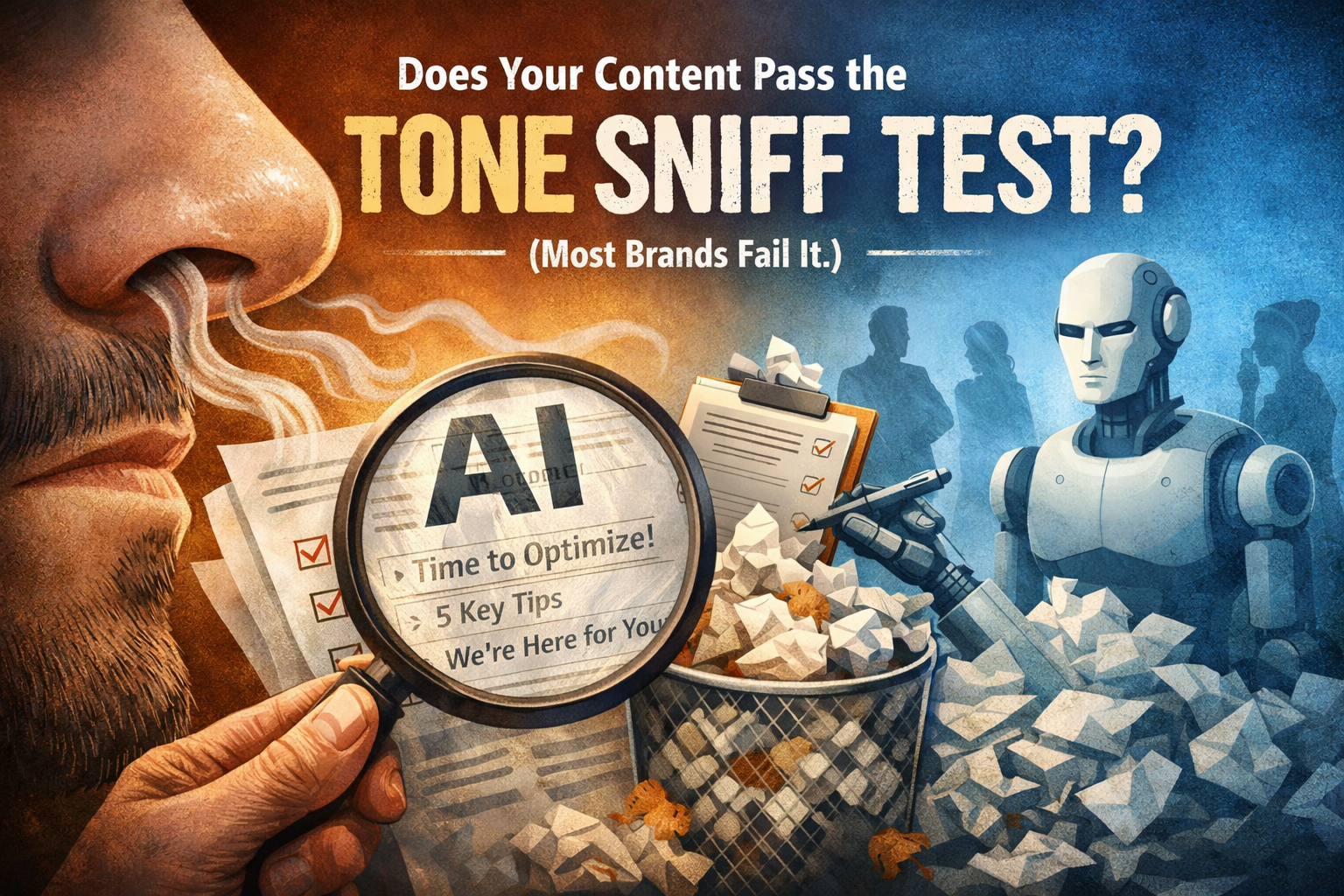
Humans can “smell” inauthentic writing before they can explain it.
That instinct is called the Tone Sniff Test – and most brands fail at it because they can’t cheat it.
You see, we’ve developed some pretty sharp, keen senses when it comes to spotting tone. Even when we’re babies, we pick up on differences in how the voice rises and falls, or whether or not there’s tension or shortness in someone’s voice. We may not be able to communicate it, but we recognize it.
Then as adults, that same wiring gets more refined and more sophisticated. We get better at sniffing out the inauthentic, unoriginal and nonsensical.
And this is where AI content fails miserably.
Tell-Tale Signs Your Content Won’t Pass the Sniff Test
So how do you know if your content can pass the sniff test? Here are a few tell-tale signs:
It’s Over Polished
AI content reads like something laminated. It’s polished to a glossy sheen. The cadence is the same to the point where it’s almost predictable. Real human writing has fingerprints. There are tiny pauses, rhythm changes and even minor imperfections. Readers can tell when text has been dragged (kicking and screaming) through a focus group until it’s bland, boring and utterly forgettable.
Generic Empathy
This is also called “Therapy Voice” and AI is positively marinated in it. AI defaults to this comforting but emotionally hollow-sounding language like “It’s a challenge we all face”, or “Here are five ways to improve…” It’s the LLM attempt at feigning empathy without experience, so it reads as if it came from someone who has never experienced a bad day in their life, but instead read about one on a LiveJournal blog once back in 2008.
There’s No Lesson Learned
AI writing likes to talk about challenges and journeys and lessons learned, but it seems to conveniently sidestep the important parts, like:
What was difficult?
Which lesson was the hardest?
Why wasn’t it easy?
The LinkedIn Cadence
AI loves patterns. It was built on them, so naturally it defaults to them when it’s coming up with the next word in the sequence. And if you’ve been on LinkedIn any length of time, you’ve already spotted it:
Short sentence
Shorter sentence
Punchline sentence
Then a bulleted list (with or without emojis)
Human writing that passes the sniff test breaks out of templates. We write in a mix of short and long sentences, brief pauses and full stops so that points and emotions actually land.
The Delight is in the Details
Humans delight in details. The more specific someone’s lived experience, the more we perk up and listen. We share the exact sentence, the odd smell, the unexpected joy, the embarrassing thought or the little moment that changed everything. AI glosses right over that specificity because it doesn’t fit into its neat little patterned parameters.
What AI does is aim to delight the user. It so desperately wants to be helpful, to the point that, unless it’s otherwise prompted, it will avoid emotions like:
Anger
Disappointment
Frustration
Aggression
Danger
Surprise
Humans meanwhile, we take positions. We feel things and we let others know about them. Otherwise our writing comes through as painfully artificial.
The Biggest Tone-Smell Fail of All
The real question to ask yourself when figuring out if your content (or anyone else’s) passes the tone sniff test is this:
Can you tell what the author believes?
Even if you don’t agree with it, do you understand their stance on things? Do you see what they value? Can you put yourself in their shoes and see what they’ve lived or what hill they’d die on?
AI can explain this, but it won’t choose one. Readers trust those who choose.
So, Does Your Content Pass?
The uncomfortable truth of the matter is that you can optimize copy for SEO all day long, polish it up for perfect brand voice and smooth out all the rough edges, but it won’t pass the prospect’s tone sniff test.
Tone is one of those things that isn’t a tactic. It’s not something brands can cheat, which is why so many fail at it. Readers trust writing that sounds lived in and comfortable, like an old sweatshirt. When page after page is saturated with AI writing, the brands that win will be the ones that are willing to:
Take a position
Risk being specific
Letting friction and opinion stay woven in the work
That kind of presence can’t be faked, templated or generated – and trust me, your audience knows the difference.